Corporate Governance
■Basic Views
Based on the mission (Group Mission) of SMS and its subsidiaries (Group) of improving people’s quality of life by providing information infrastructure for an aging society, the Group strives to achieve sustainable growth and increase its corporate value over the long term by valuing all stakeholders including shareholders, customers, business partners, employees, and local communities. The markets for medical care, elderly care, disability care, healthcare, and senior life, which are the business domains of the Group, are growing at an accelerating pace and changing rapidly. Therefore, the Company must make swift and decisive management decisions. At the same time, it is essential to build a sound management system with transparency and fairness to earn the trust of all stakeholders.
Corporate governance is a framework for achieving transparent, fair, and swift management decision-making. The Company believes it is important to ensure effective corporate governance to realize the Group Mission and increase its corporate value over the long term. Based on this recognition, the Company will achieve effective corporate governance through the following basic policies:
(1) Ensuring the Rights of and Equality among Shareholders
(i) Ensuring the Rights of Shareholders
The Company discloses information in a timely and appropriate manner and strives to improve the environment in which shareholders can exert their rights to ensure substantial equality among all shareholders, including minority and/or foreign shareholders and the appropriate exercise of their rights.
(ii) General Shareholders Meetings
The Company believes that a General Shareholders Meeting is an opportunity for constructive dialogue with shareholders. To enable shareholders to exercise their voting rights appropriately, the Company sets out in the convocation notice the accurate information necessary for voting decisions, and also posts the notice on TDnet and the Company's website prior to its dispatch.
(iii) Capital Policy
The Company believes it is essential to contribute to shareholder value by achieving sustainable growth and increasing its corporate value over the long term. The Company aims to achieve continuous growth in revenue and EBITDA, and maintain a higher ROE than its cost of equity by efficiently utilizing its limited management resources. As huge business opportunities emerge in the market related to an aging society where the Group operates, the Company will use its profits for the investments necessary for sustainable growth and long-term corporate value enhancement.
Capital policies that may affect the rights of existing shareholders, such as large-scale capital increases, shall be conducted through appropriate procedures based on a thorough consideration of its necessity and rationality not to harm the rights of shareholders unduly.
The Company's basic policy for profit distribution is to implement a progressive dividend policy* targeting a consolidated dividend payout ratio of 30%, while prioritizing investments for growth and taking our financial condition into account. Exceptions may apply in cases of significant capital allocation opportunities, such as strategic M&A.
* Policy to maintain or increase the dividend per share compared to the previous fiscal year.
(iv) Cross-Shareholdings
The Company does not hold any listed shares under a so-called “cross-shareholdings” structure. The Company will not hold such shares if it is not possible to reasonably explain that such shares will lead to long-term enhancement of corporate value after comprehensive considerations of factors including consistency with the Group's strategy, synergy effects, and risks.
(v) Adoption of Takeover Response Policies (or Anti-Takeover Measures)
The Company believes that achieving sustainable growth and long-term enhancement of corporate value and building good relationships with shareholders and investors through IR activities will defend against hostile takeovers. Therefore, the Company has not adopted takeover response policies (anti-takeover measures).
(vi) Related Party Transactions
The Company conducts all transactions through the necessary screening and approval process depending on the transaction scale and significance following internal regulations.
Any transaction which may cause conflicts of interest is subject to the prior approval of the Board of Directors and is required to be reported to the Board after it is carried out.
Related party transactions are conducted by taking into account the general terms and conditions of transactions in the market, and the status of such transactions is monitored to prevent any disadvantages to the Company. The Company discloses related party transactions in the annual securities report and non-consolidated financial statements attached to the convocation notice for the General Shareholders Meeting.
(2) Appropriate Cooperation with Stakeholders Other Than Shareholders
The Group Mission states that the Company aims to continue contributing to society through its business activities. To this end, it is essential to build good relationships and cooperate with all stakeholders, including shareholders, customers, business partners, employees, and local communities. The Company's basic stance toward each stakeholder is as follows:
- For customers: The Company values customers (operators, workers, and end-users) through its information-based services.
- For business partners: The Company builds sound coexistence relationships with business partners by procuring products and services of appropriate quality at appropriate prices. In pursuit of the mission, initiatives toward a sustainable society across the entire supply chain are essential; to this end, the Company has established the "Sustainable Procurement Policy" and "Supplier Code of Conduct," and is working toward the realization of a sustainable supply chain.
- For employees: The Company provides employees with various growth opportunities through the sustainable growth of its business and aims for mutual development between the Company and employees.
- For local communities: The Company contributes to the sustainable development of local communities by solving various social issues that arise in an aging society through its business activities.
(3) Ensuring Appropriate Information Disclosure and Transparency
The Company believes that it has the responsibility to disclose appropriate information on a timely basis and sufficiently fulfill its accountability. In addition to ensuring disclosures in compliance with relevant laws and regulations, including the Companies Act, the Financial Instruments and Exchange Act, and the rules of the Tokyo Stock Exchange, the Company discloses information that may affect the investment decisions of shareholders and investors, in a timely and appropriate manner.
(4) Responsibilities of the Board of Directors
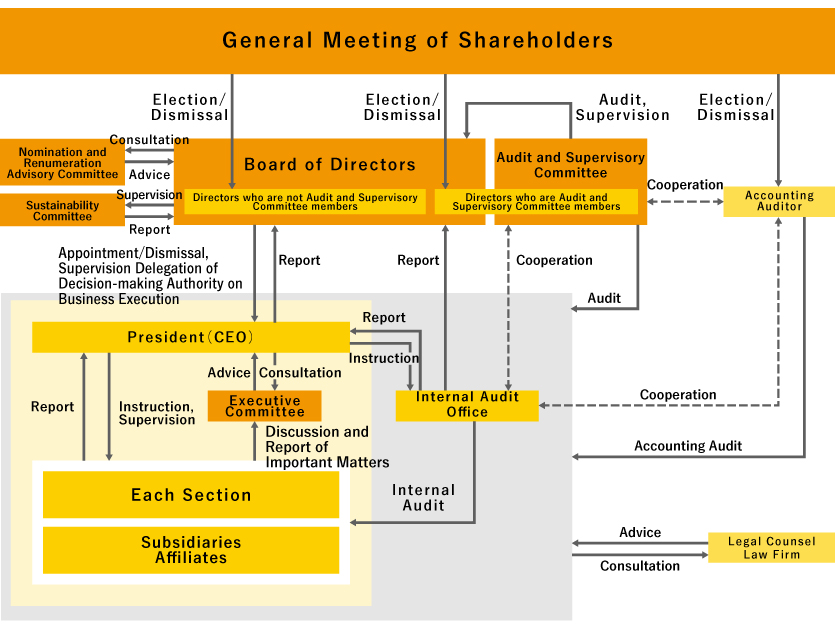
As a Company operating in a market that is accelerating and changing rapidly, it is imperative to build a management system that enables swift and sound management decisions in a timely and appropriate manner to realize the Group Mission and increase its corporate value over the long term. Therefore, the Company has adopted an organizational form of a company with an Audit and Supervisory Committee and the authority of the business execution of the Board of Directors has been delegated to the Representative Director and President (CEO), and other Directors. The Board of Directors focuses on substantial discussions regarding management strategies and issues from a broader perspective and enhances its supervisory function over business execution. At the Audit and Supervisory Committee, the Committee members who have the voting rights of the Board of Directors (all are Independent Outside Directors) conduct audits to improve the effectiveness of audit and supervision. The Company has also established the Nomination and Remuneration Advisory Committee to ensure objectivity, fairness, and transparency in the nomination of Director candidates, the appointment/dismissal of the senior management, and the remuneration decision for Directors who are not the Audit and Supervisory Committee members. To realize the most appropriate composition of the Board of Directors suitable for a rapidly changing business environment, the Company has set the policy for the nomination of Director that requires candidates to have a deep understanding of the Company's business along with a wealth of experience and broad insight in areas such as finance, accounting, legal affairs, and/or corporate management, regardless of age, gender, or nationality. Specifically, the Company aims to achieve diversity among the members of the Board of Directors in terms of their backgrounds, areas of expertise, and international experience. The Company believes that the above system enables the Directors to fulfill their duties.
Thereby the Company will realize the Group Mission and increase its corporate value over the long term.
(5) Dialogue with Shareholders
The Company recognizes that it must engage in constructive dialogue with shareholders and investors with a long-term perspective to realize the Group Mission and increase its corporate value over the long term. Therefore, the CEO supervises dialogue with shareholders, and the policy of the dialogue is decided in cooperation with the IR section. The CEO explains the management strategies and the business conditions at quarterly results briefings, and the IR section actively responds to individual interviews. In addition, opportunities for dialogue between Outside Directors and shareholders are provided as necessary.
<Corporate Governance Structure>